
Kazakhstan Real Estate Market Guide for Foreign Buyers
Kazakhstan’s real estate market offers foreign buyers a mixture of opportunity and caution. The country’s two largest cities, Almaty and Astana, dominate residential activity, while expanding construction and government efforts to attract foreign investment are creating new opportunities. But anyone considering buying property needs to understand ownership rules, the climate, living conditions and the bureaucracy that comes with doing business in Kazakhstan.
The market remains active despite signs of moderation. In July 2026, Kazakhstan recorded 37,158 residential property transactions, down 4.9% from June and 6.5% from July 2025. Almaty accounted for 19.5% of transactions and Astana for 18.8%, making them the country’s two most important residential markets. Apartments represent nearly 77% of transactions.
The recent slowdown follows a strong period for property prices. Major cities experienced substantial price increases during 2025 and early 2026, supported by mortgage lending, population growth and continued demand for new housing. Analysts now see signs that high borrowing costs and rising prices are beginning to restrain demand.
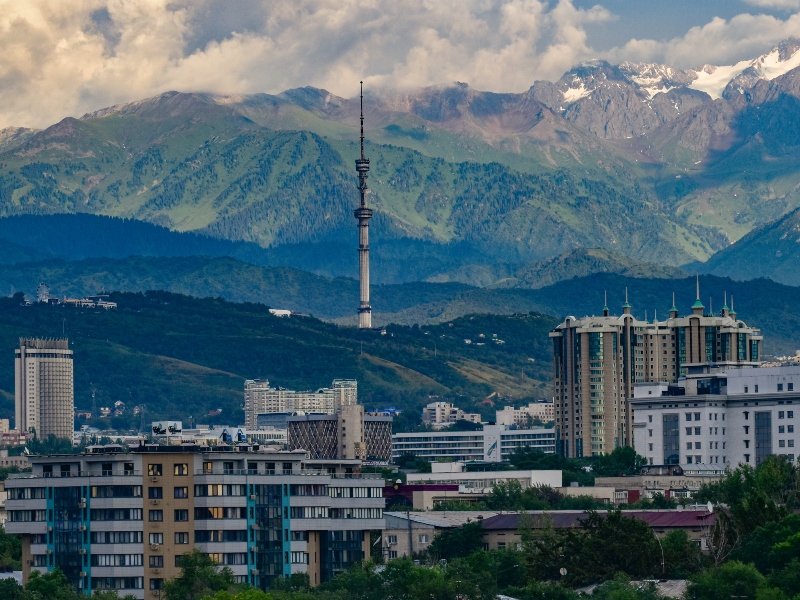
For a foreign buyer, Almaty is generally the country’s most established property market. It is Kazakhstan’s largest city and commercial centre, with a relatively international atmosphere, restaurants, shopping, universities and established business services. Its location near the mountains also gives it a more attractive lifestyle for many expatriates.
Astana offers a different proposition. The capital has undergone rapid development, with modern apartment buildings, offices and government infrastructure. It can be attractive to people working for government institutions, international organisations and companies involved in construction and infrastructure. However, its climate is much harsher than Almaty’s.
Kazakhstan has a continental climate, meaning temperatures can vary dramatically between summer and winter. Almaty has hot summers and cold winters, while Astana is known for particularly severe winters, strong winds and very low temperatures. Climate therefore matters when buying a property, especially for people accustomed to warm countries. Heating systems, insulation, building quality and access to transport become practical considerations rather than minor details.
The government is also trying to make Kazakhstan more attractive to foreign capital and skilled professionals. In 2026, President Kassym-Jomart Tokayev ordered reforms aimed at simplifying and digitising immigration procedures and creating more favourable conditions for foreign investors and highly skilled workers. The government has been tasked with implementing these reforms by the end of 2026.
Foreigners can generally own residential property in Kazakhstan, subject to the country’s legal requirements. Kazakhstan’s housing legislation recognises private ownership of dwellings, although other laws can impose restrictions. The most important restriction for foreign investors concerns agricultural land. Foreigners and foreign-controlled entities face significant legal restrictions on owning or using agricultural land, making farmland a very different proposition from buying an apartment or commercial property.
The construction pipeline is another reason to watch the market. Kazakhstan commissioned about 8.47 million square metres of housing during the first half of 2026, an increase of 6.7% from the same period in 2025. The government expects 18.5 million square metres of housing to be commissioned during 2026, with large volumes planned for Astana, Almaty and Shymkent.
The main difficulty for foreigners may not be finding a property but completing the transaction correctly. Property purchases can involve registration, documentation, taxation, banking requirements and verification of ownership. Language can also be an issue because Kazakh and Russian remain dominant in everyday administration, while English is more common in international business.
Bureaucratic reforms are under way, but they do not eliminate the need for local assistance. A foreign buyer should use an independent lawyer or qualified property professional, verify the property’s title and outstanding obligations, and ensure that all documents are properly translated where necessary. Buyers should also distinguish between owning a property and having the right to reside or work in Kazakhstan. Purchasing an apartment does not automatically solve immigration requirements.
For people considering Kazakhstan as a place to live, Almaty may offer a more comfortable lifestyle, while Astana may appeal more to those prioritising the capital’s modern infrastructure and employment opportunities. Other cities can offer lower property costs, but they may have smaller expatriates communities and fewer international services.
Overall, Kazakhstan’s real estate market is worth considering, particularly for buyers interested in Almaty and Astana and willing to take a long-term view. The market is no longer simply a story of rapidly rising prices. Demand remains substantial, construction is expanding and government policy is becoming more welcoming to foreign capital, but financing costs, price levels and administrative requirements need careful consideration.
For a foreign buyer, the safest approach is to treat Kazakhstan as a market requiring local knowledge rather than a quick property opportunity. Good location, verified ownership documents, professional legal advice and realistic expectations about bureaucracy can make the difference between a sound investment and an expensive mistake.