
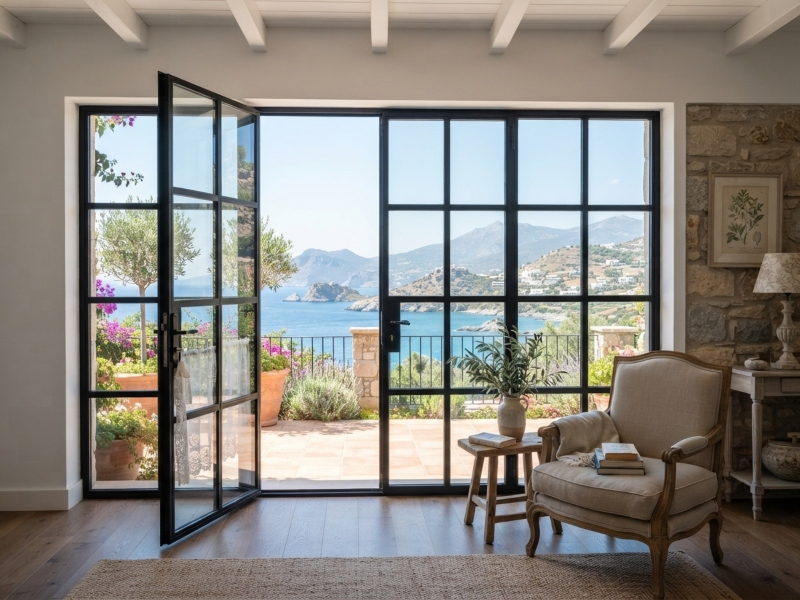
Are uPVC Windows Good for Hot Climate?
uPVC windows and doors have become increasingly common in Pakistan as homeowners look for better insulation, lower maintenance and protection from heat, dust and outside noise. They are now widely available in Lahore, Islamabad, Rawalpindi, Karachi and other major cities. But the material is not automatically a better choice than aluminium. The quality of the profile, reinforcement, glass, hardware and installation can make a bigger difference than the material name printed on the quotation.
uPVC stands for unplasticized polyvinyl chloride. Unlike flexible PVC products, uPVC is a rigid material developed for applications such as window and door frames. Its low thermal conductivity gives it an insulating advantage over conventional aluminium frames, which conduct heat readily. The U.S. Department of Energy also identifies vinyl and other non-metal frames as having greater thermal resistance than standard metal frames.
For Pakistan, this matters because windows are one of the weaker parts of a building’s thermal envelope. A well-designed window can reduce unwanted heat entering a room and help an air conditioner work less. But the frame is only part of the equation. The glass area is often much larger than the frame, so the glazing specification can have a major effect on actual performance.
Double glazing is therefore worth considering, particularly for bedrooms, living rooms and west-facing windows. It uses two panes of glass separated by an insulating space. Low-E glass can go a step further by reducing radiant heat transfer and solar heat gain. In hot climates, lower solar heat gain is generally desirable because it limits the amount of heat entering the room through the glass.
The practical benefits of uPVC are straightforward. Good-quality systems provide thermal insulation, resist moisture and termites, and do not require the regular painting associated with many traditional frames. They can also provide good protection against dust and outside noise when the frame, seals, hardware and installation are properly designed. Some Pakistani suppliers offer casement, sliding, tilt-and-turn and other systems using imported and locally fabricated profiles.
Heat, however, deserves attention. uPVC is a thermoplastic material, so it expands and contracts with temperature changes. International standards for window-grade PVC-U profiles include requirements for properties such as Vicat softening temperature, with EN 12608 specifying an average minimum of 75°C for the relevant test. That should not be interpreted as meaning a window frame can simply be exposed to any surface temperature below or above that figure without consequences. Actual performance depends on profile design, reinforcement, color, dimensions, orientation and installation.
This is particularly relevant in cities such as Multan, Bahawalpur and parts of Sindh, where intense summer sunlight can heat exposed surfaces considerably. Dark-colored frames can absorb more solar radiation than white or light-colored frames. Large openings can also place greater demands on the profile and reinforcement.
That does not mean uPVC should be avoided in hot parts of Pakistan. It means the specification needs to match the application. Large sliding doors, very wide windows and floor-to-ceiling openings deserve particular attention. For such applications, aluminium, especially thermally broken aluminium, can offer greater structural flexibility and slimmer sightlines. Standard aluminium, however, is a much better heat conductor than uPVC, so comparing only the frame material without considering thermal breaks is misleading.
The choice also depends on the look you want. uPVC frames are generally bulkier than modern aluminium systems. That can matter when designing contemporary homes with large glass panels. On the other hand, the thicker uPVC frame can provide useful insulation and a strong sealing system.
Pakistan has a growing range of uPVC suppliers and profile systems. Deceuninck is one established international profile brand available through companies such as Unitherm in Pakistan. Unitherm says it is the exclusive Pakistani distributor of Deceuninck and has manufacturing facilities serving the local market. Other products available in Pakistan include Turkish systems such as ASAS and Wintech, while local companies such as Smart Window manufacture uPVC profiles and window systems for the Pakistani market. These are examples to investigate, not a ranking of brands.
The most important point when buying is not to choose a window simply because the salesperson calls it “German,” “Turkish” or “European.” Ask for the actual profile manufacturer, profile series, reinforcement specification, glass type, hardware brand and warranty. For large openings, ask how the design has been engineered for the opening size and local weather conditions.
The Pakistani market also contains imitation and poorly specified products sold under familiar-sounding names. Check the profile markings, documentation and authorized dealer or fabricator status before paying a substantial advance.
For a Lahore or Islamabad house with conventional window sizes, good-quality white or light-colored uPVC with properly specified double glazing can be a sensible option. In particularly hot locations, careful orientation, external shading and appropriate solar-control glass can be just as important as the frame material. West-facing windows deserve special attention because afternoon solar exposure can produce substantial heat gain. External shades, overhangs and screens can help control it.
For very large doors, panoramic windows or projects where slim frames are a major design requirement, thermally broken aluminium deserves serious consideration. It normally costs more than basic aluminium, but its thermal break addresses one of the main weaknesses of conventional metal frames.
The right question for a Pakistani homeowner is therefore not simply “uPVC or aluminium?” A better decision considers the complete window: frame profile, reinforcement, glass, solar control, seals, hardware, opening size and installation. A cheaper frame with poor glass and careless installation can perform badly, while a properly designed window system can deliver much better comfort and durability.