
Automatic vs Semi-Automatic Food Packaging Machines in Pakistan
Choosing between an automatic and semi-automatic food packaging machine can affect labor costs, production capacity, packaging consistency and the ability to expand a food business. For Pakistani manufacturers, the right choice depends less on whether automation sounds attractive and more on the product, daily production volume, packaging format, available labor, power supply and budget.
This decision matters to businesses ranging from spice and rice packers to bakeries, snack manufacturers, dairy processors, frozen food companies and ready-to-eat food producers. A machine that is too small can become a production bottleneck, while an expensive automated line may leave a small producer paying for capacity it does not use.
Semi-automatic machines: A semi-automatic packaging machine keeps an operator involved in one or more stages of the process. The worker may load products, position containers or start a packaging cycle, while the machine performs tasks such as filling, sealing or wrapping.
This approach can make sense for small and medium-sized Pakistani food businesses, particularly those producing several products or changing package sizes frequently. A bakery, butcher, small snack producer or regional food brand may benefit from the flexibility without making the capital investment required for a fully automated line.
The main advantage is flexibility. If a company packages different products, weights or container sizes, changing between jobs may be easier than on a highly integrated production line. Maintenance and operator training can also be simpler, depending on the machine.
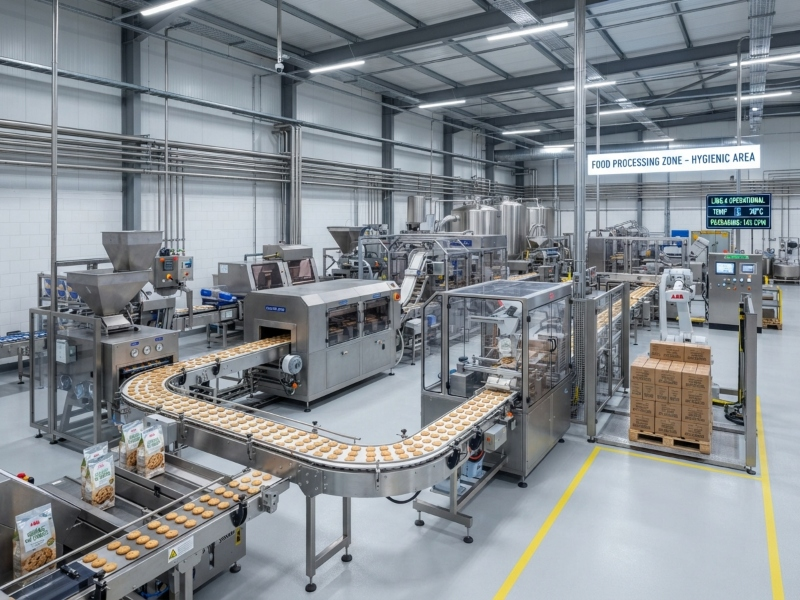
Automatic machines: Automatic packaging equipment reduces manual handling and can connect several stages of the packaging process. Depending on the system, these can include feeding, weighing, filling, bag forming, sealing, coding, checking and conveying.
Vertical Form Fill Seal, or VFFS, machines are widely used for products such as spices, rice, pulses, snacks, sugar, tea and powdered foods. The machine forms a bag from packaging film, fills it and seals it. Other packaging systems are designed for liquids, trays, bakery products and other food formats.
The benefit of automation is consistent production and higher potential throughput. For example, Nichrome’s automated VFFS machines include models designed for snacks, grains, spices, coffee and other food products, with published capacities varying significantly by machine and product. Its Sprint 250 Plus, for example, is specified for up to 120 packs per minute under stated conditions.
What works better for a Pakistani factory: There is no universal answer. A small manufacturer selling several products in relatively limited quantities may find a semi-automatic machine more practical. A company supplying supermarkets, wholesalers or large institutional buyers may need automatic equipment when manual packaging becomes a constraint.
The important calculation is not simply the number of packs a machine can produce per minute. A buyer should calculate actual daily demand, working hours, changeover time, product wastage, number of operators, film consumption, electricity requirements and expected machine downtime.
| Factor | Semi-Automatic | Automatic |
|---|---|---|
| Initial investment | Generally lower | Generally higher |
| Labor involvement | Higher | Lower |
| Production capacity | Suitable for small to medium production | Suitable for medium to high production |
| Product changes | Often more flexible | Can require more planning |
| Packaging consistency | Depends partly on operator | Generally more consistent |
| Maintenance | Often simpler | Can require trained technicians |
| Best suited to | Small and growing producers | Established high-volume production |
What to check before buying: Pakistani buyers should pay particular attention to after-sales service. A machine that remains idle for several days because a sensor, controller, sealing component or other spare part is unavailable can cost more than the initial price difference between two machines.
Electrical requirements also deserve attention. Some industrial machines require three-phase power, while others have specific requirements for compressed air, cooling water or stabilized electricity. In Pakistan, where voltage fluctuations can affect equipment, the supplier should clearly specify electrical protection and power-quality requirements.
The packaging material is equally important. The machine must be compatible with the film, laminate or pouch structure being used. A machine that performs well during a demonstration may behave differently with the actual product and packaging material used in production.
Options available in Pakistan: Local and regional suppliers provide a range of equipment. Detechnics, a Pakistan-based packaging machinery manufacturer, lists horizontal form-fill-seal machines, biscuit packaging equipment, wafer production lines and other automated packaging solutions.
Geco Pakistan supplies both automatic and semi-automatic packaging machinery for industries including foodstuff, filling, sealing and container handling.
For larger food manufacturers, FEI Pakistan states that it works with international packaging equipment companies including Ishida, SPS, CAMA and Theegarten, offering packaging solutions for food manufacturers.
International manufacturers such as Nichrome also offer specialized VFFS and other packaging systems for food products. Its portfolio covers applications including snacks, grains, spices, coffee, tea, sugar and liquids.
When comparing brands or models, buyers should therefore look beyond the machine name. Availability of local technical support, spare parts, installation, operator training and warranty service can be just as important as the advertised production speed.
Be careful with unusually cheap machines or branded equipment offered without verifiable documentation. Pakistan’s market contains counterfeit and refurbished equipment, so check the manufacturer’s model number, serial number, documentation and authorized supplier before making a substantial payment.
The practical approach: For a small food producer, semi-automatic equipment can be a sensible starting point when production is still developing. Once labor, consistency or packaging capacity becomes a genuine constraint, automation can be introduced where it produces a measurable benefit.
For larger manufacturers, a complete packaging line may make more sense than buying individual machines without considering the entire process. Weighing, filling, sealing, coding, inspection, conveying and secondary packaging need to work together.
The best packaging machine is therefore the one that matches the product and the factory’s actual production requirements. In Pakistan, the purchase decision should be based on total operating cost, technical support and realistic production needs rather than the highest advertised speed or the lowest purchase price.