Toyota Corolla Cross 2026 Review
Toyota Corolla Cross has become one of the most important locally assembled SUVs in Pakistan, particularly because it introduced Toyota’s hybrid technology to a locally manufactured vehicle. Since its launch, the Corolla Cross has established itself as a serious option for buyers looking for an SUV with better fuel efficiency, modern features and Toyota’s established reputation for reliability. However, its relatively high price means that its advantages need to be weighed carefully against what competing vehicles offer.
The Corolla Cross is a compact SUV designed primarily for urban driving, family use and highway travel. The locally assembled model is built around a 1.8-liter engine, while the hybrid version combines a petrol engine with an electric motor. Toyota’s hybrid system can operate the vehicle using electric power in suitable conditions, combine the engine and electric motor when more power is needed, and recover energy during braking. This helps reduce fuel consumption, particularly in stop-and-go city traffic.
One of the biggest strengths of the Corolla Cross Hybrid is its fuel efficiency. Toyota says its locally manufactured Corolla Cross HEV can improve fuel mileage substantially compared with conventional vehicles, while also reducing emissions. The hybrid system also produces smooth acceleration and a relatively quiet driving experience. For people who drive regularly in congested cities, this is probably the strongest reason to choose the hybrid version over a conventional petrol SUV.
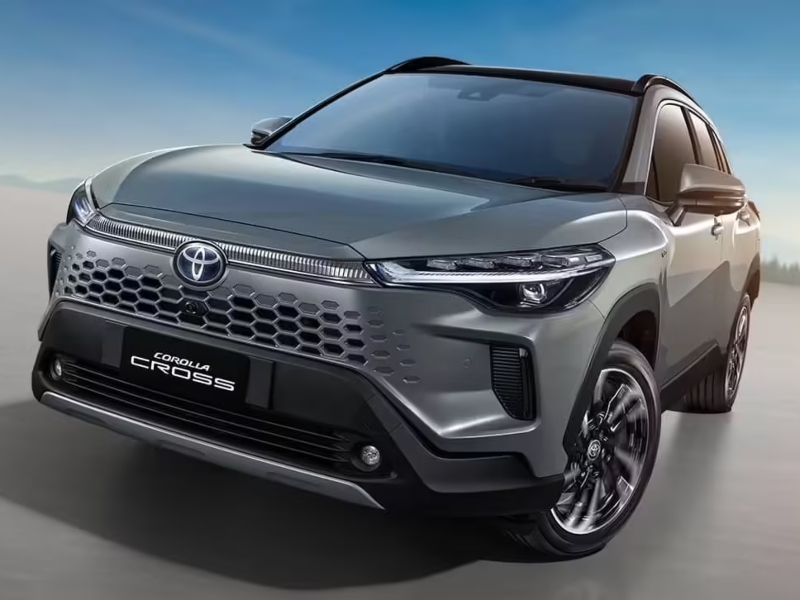
The car also offers the advantages of an SUV without the size and fuel demands of a much larger vehicle. Its 4,460 mm length, 1,825 mm width and 1,620 mm height give it a substantial road presence while keeping it practical for everyday use. The Toyota New Global Architecture platform is designed around ride comfort, handling and overall vehicle performance.
Features are another attraction. Depending on the variant, the Corolla Cross offers equipment such as LED lighting, alloy wheels, smart entry, multiple driving modes and safety features including a blind-spot monitor. The higher hybrid version is positioned as the more feature-rich choice. Toyota also provides a nationwide authorized dealer network, which remains a major advantage in Pakistan for servicing and parts availability.
Local assembly is important beyond the car itself. Indus Motor Company describes the Corolla Cross as Pakistan’s first locally manufactured hybrid electric vehicle and says it has the highest local content among its locally produced SUVs. The project has also contributed to localization and the development of local suppliers. This gives the model significance for Pakistan’s auto industry as well as for individual buyers.
The biggest disadvantage remains the price. Current authorized-dealer listings show the 2026 Corolla Cross 1.8 petrol starting at about Rs7.26 million, while the hybrid versions are listed at roughly Rs9.87 million and Rs10.32 million, depending on the variant. These are ex-showroom Karachi prices and can change, so buyers should confirm the final price, taxes and delivery charges before booking.
This price difference makes the hybrid difficult to justify for buyers who drive relatively few kilometers each year. The fuel savings can be meaningful, but recovering the additional purchase cost depends heavily on annual mileage, fuel prices and how long the vehicle is kept. For a high-mileage city driver, the calculation is more favorable than for someone who uses the car mainly on weekends.
Another limitation is performance. The Corolla Cross is designed primarily for comfort, efficiency and everyday practicality rather than aggressive driving or serious off-road use. Its hybrid system provides smooth and responsive performance, but buyers expecting the power and ruggedness of a larger SUV may find it less appealing. Ground clearance and SUV styling should not be confused with the capabilities of a true four-wheel-drive off-road vehicle.
Long-term hybrid ownership is also a consideration. Toyota’s hybrid technology is now well established internationally, and the locally assembled Corolla Cross uses Toyota’s fourth-generation hybrid battery system. Nevertheless, the hybrid system is technically more complex than a conventional petrol powertrain, and potential buyers should consider battery warranty, replacement costs and the availability of qualified hybrid technicians before making a long-term ownership decision. Toyota’s own description of the system points to fewer conventional powertrain components and potentially lower maintenance requirements, but that does not eliminate every long-term cost.
Overall, the Toyota Corolla Cross makes the strongest case for itself as a comfortable family SUV for buyers who value fuel economy, reliability, resale prospects and an established service network. The hybrid version is particularly attractive for people who spend substantial time driving in city traffic. But its high purchase price means it is not automatically the best value in the market. For buyers who drive less, the petrol version may make more financial sense, while those seeking maximum features or stronger performance should compare competing SUVs before deciding. The Corolla Cross is therefore an important step forward for Pakistan’s automotive industry, but its success as a consumer product will ultimately depend on whether its fuel savings and Toyota ownership advantages justify its premium price.