D8 economic bloc sets $500 billion trade target for 2030
The Developing-8 organization, an economic cooperation bloc of nine Muslim-majority countries, has set an ambitious goal to nearly quadruple trade among its members from about $150 billion to $500 billion by 2030. The announcement came as Indonesia, which holds the group’s chairmanship for 2026-2027, opened the D-8 Halal Expo in Jakarta on July 8.
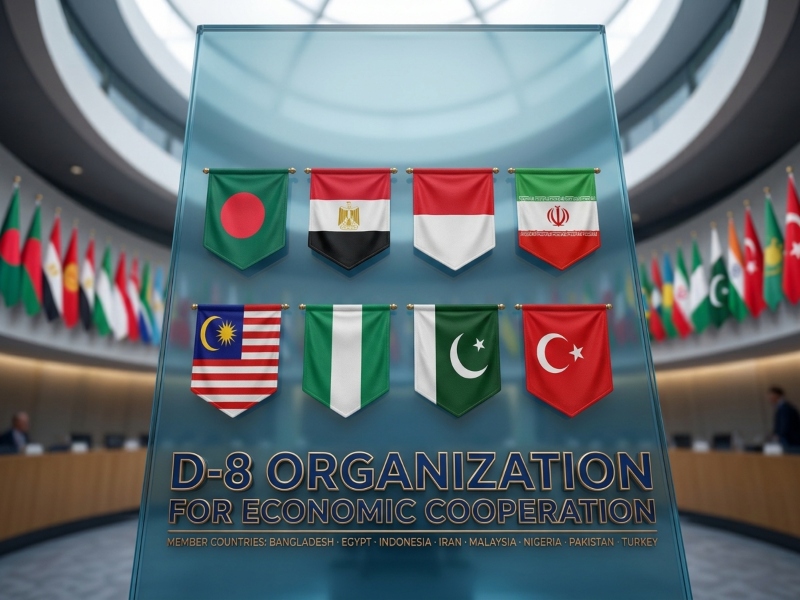
The D-8 was founded in Istanbul in 1997 and originally included eight countries: Bangladesh, Egypt, Indonesia, Iran, Malaysia, Nigeria, Pakistan, and Turkey. Azerbaijan joined as the ninth member in late 2024. The bloc represents approximately 1.3 billion people with combined GDP exceeding $5 trillion. The group was established to improve its member states’ positions in the global economy, diversify trade, and create new opportunities for international relations.
Indonesian Deputy Foreign Minister Anis Matta said at the expo’s opening that current intra-bloc trade stands between $150 billion and $160 billion. He stated that the group is systematically addressing trade barriers related to tariffs, logistics, and regulations to reach its target, which was first set in the D-8 Decennial Roadmap for 2020-2030. The roadmap outlines specific goals for economic integration, including the expansion of the bloc’s preferential trade agreement, which lowers or eliminates tariffs on goods traded among member countries.
The halal economy is central to the bloc’s strategy. Halal refers to products and services permissible under Islamic law, and the market extends far beyond food to include cosmetics, pharmaceuticals, modest fashion, finance, and tourism. Egyptian Ambassador Yasser Hassan Farag Elshemy said the halal sector could account for more than 45 percent of member economies in the future. Currently, countries outside the D-8 dominate global halal production. China is the world’s largest halal products producer, followed by Brazil and the United States, according to Indonesia’s Halal Assurance Agency.
To address this, D-8 members are pursuing mutual recognition agreements for halal certification. Under these deals, countries recognize each other’s halal certificates, making it easier for products to cross borders without requiring duplicate inspections or re-certification. Pakistan has already signed such agreements with Indonesia. The bloc is also exploring a shared halal logo to further harmonize standards across its member states. This would simplify compliance for exporters and build consumer trust in D-8 products.
Beyond halal products, the D-8 is focusing on digital economy cooperation, artificial intelligence, pharmaceuticals, and automotive parts. The digital economy is seen as a particularly promising area, given the bloc’s young and increasingly connected population. Officials have proposed a D-8 Business Visa to simplify travel for entrepreneurs and investors across member states. Such a visa could reduce bureaucracy and encourage more cross-border business visits, which are often critical for building partnerships and closing deals.
D-8 Secretary General Ambassador Sohail Mahmood has emphasized that the private sector must play a central role in achieving the trade target. The bloc’s role, he said, is to create favorable conditions through policy coordination and infrastructure. The D-8 has established several institutional mechanisms, including a preferential trade agreement that lowers tariffs among its members, an agricultural research center in Faisalabad, Pakistan, and a small business center in Abuja, Nigeria. These institutions are meant to provide practical support to businesses looking to expand within the bloc.
The challenge ahead is significant. Current intra-bloc trade is less than one-third of the 2030 target. For comparison, the Association of Southeast Asian Nations, a similar regional bloc, has achieved approximately 25 percent intra-regional trade as a share of its members’ total trade in recent years. The D-8 currentlylags behind many comparable groupings. Success will depend on whether member governments can fully implement their agreements and whether businesses can take advantage of new opportunities. Political tensions among some members, varying regulatory environments, and infrastructure gaps all pose obstacles.
For companies looking to expand in Muslim-majority markets, the D-8’s progress on halal certification and trade facilitation is worth watching. The halal economy alone is estimated to be worth over $3 trillion globally, and the D-8 members represent a substantial share of that market. For the bloc’s consumers and workers, the target represents a bet that deeper regional integration can deliver jobs, technology transfer, and lower-priced goods.
The next few years will show whether this group of nine nations can turn its demographic weight and shared economic interests into a more competitive regional market. The 2030 deadline is ambitious, but the D-8 has shown willingness to address the practical barriers that have held back trade in the past.